
An enzyme claim can help narrow a laundry search, but it cannot finish the decision. You still need the stain identity, garment care instructions, and directions for the exact formula. This guide focuses on that practical match. It does not rank products by an invented enzyme score or assume that a longer ingredient list predicts better stain removal.
Begin with a stain description you can defend
Identify the spill as specifically as the evidence allows: dairy, egg, grass, dried blood, or an unknown mark. The ACI stain guide names enzyme-containing pretreatment or soaking for several of these stain types. That makes an enzyme product a category worth investigating in those situations, subject to fabric and product restrictions. It is not a promise that every formula removes every listed stain.
Use the blood and protein stain guide for that specific starting point, or the grass and mud guide for outdoor marks. Record whether the stain is fresh, old, washed, or dried. If the cause is unknown, say so rather than assigning it to a category from appearance alone. A brown patch is not enough information to identify a protein stain. A useful product search begins with what you know, what you do not know, and the garment constraints that apply either way.
Check the garment before the ingredient claim
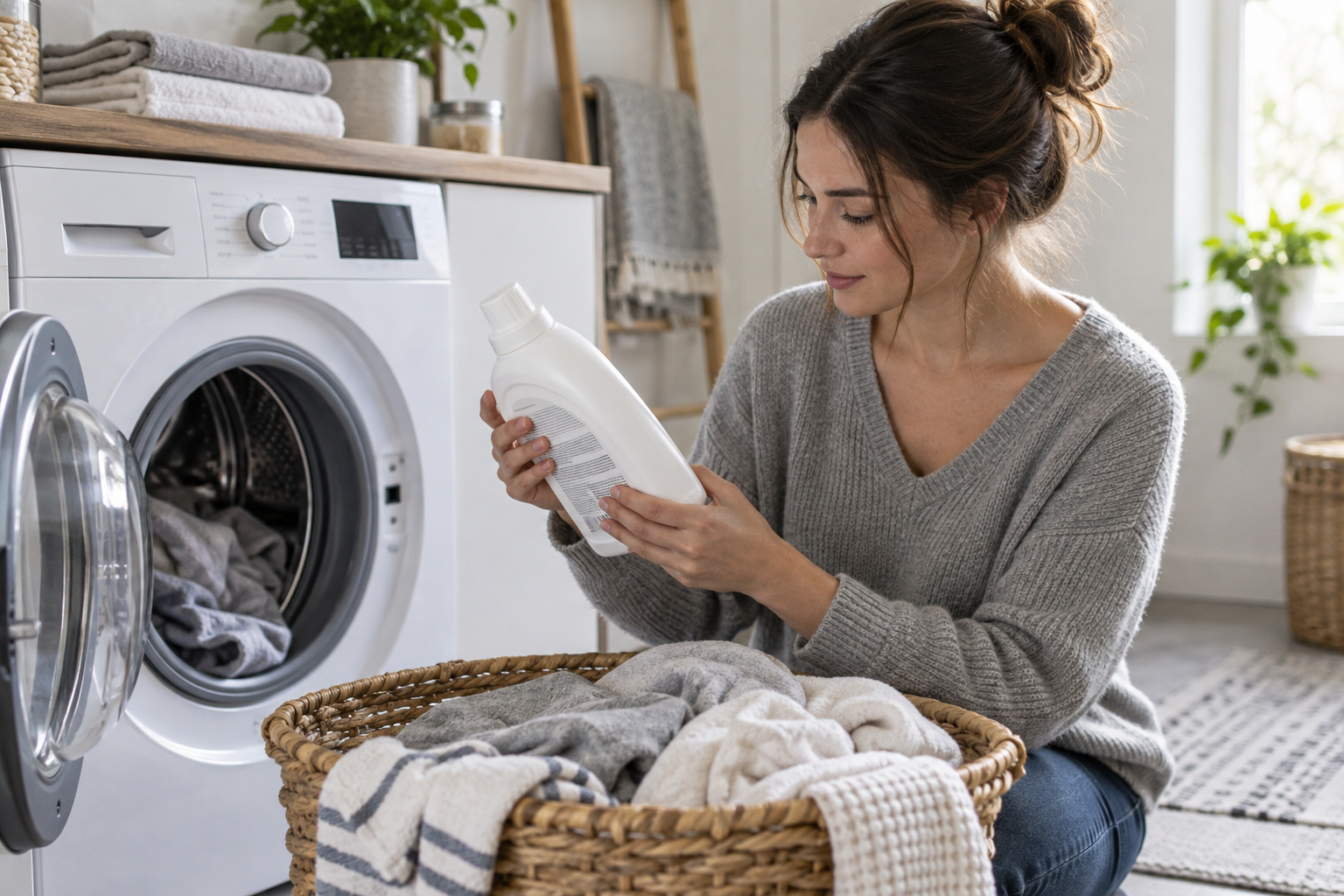
Read the complete care label, including washing, bleach, and drying restrictions. If the item requires professional care, use the delicate and dry-clean-only guide instead of assuming a laundry spray is a harmless first step. The FTC care-label guidance describes instructions and warnings for safe regular care; the presence of an enzyme in a product does not override them.
Do not infer compatibility with wool, silk, leather, a coating, or a decorative finish from a broad laundry claim. Look for explicit directions and exclusions for the formula you intend to buy or use. If the manufacturer does not support the intended material and method, the match is unresolved. Unresolved is a reason to ask, not a reason to increase the dilution until the treatment feels gentler.

Read the use directions as a complete sequence
Find out whether the product is intended for direct pretreatment, a soak, an in-wash addition, or more than one of these. Then read the corresponding directions in full. Identify the required dose, water conditions, contact time, rinsing step, and laundering requirement. A label that supports adding a product to a wash does not automatically support leaving it concentrated on a seam.
Do not borrow directions from a different brand or a different format within the same brand. Packaging can change, so use the instructions on the product you actually have and consult the manufacturer when they are unclear. If you cannot complete the required next step, wait until you can. Applying treatment before leaving home is unhelpful if the instructions require rinsing or washing sooner than you will return.
Use a material test and an ordinary observation
Follow the product's material spot-test directions on a hidden area representative of the stain location. Read the care-label and testing guide if you are unsure how to choose that area. Evaluate the result after the specified rinse and drying rather than relying on how the wet fabric looks. Stop for transferred dye, changed texture, fading, or altered sheen.
If the test is acceptable and both labels permit the use, treat the stain as directed. Keep your observation simple: unchanged, reduced, removed, or fabric changed. These descriptions are more honest than estimating a removal percentage from a casual visual check. A successful treatment on one cotton shirt does not establish performance on another fabric, another stain, or another formulation.
Keep mixed stains and chemical mixtures separate
A single spill can contain several components. Milky coffee, for example, gives you a beverage stain and information about dairy. The coffee and tea guide explains how to keep that knowledge within one label-led treatment plan. You do not need to combine multiple cleaners to acknowledge that a stain is complex.
Never mix cleaning products or add household chemicals to create a stronger treatment. The Washington Department of Health warns about dangerous bleach reactions with ammonia, acids, and other cleaners. Do not assume an enzyme product can be combined with bleach because both sit in the laundry aisle. Follow only supported product directions, and clarify earlier treatments before applying anything to a garment another person has already worked on.
Choose and evaluate without a fabricated score
When comparing candidates, prioritize a documented permitted use, a relevant stain claim, clear exclusions, and practical directions you can follow. Consider whether you need a localized applicator or a product intended for a larger wash, but do not treat format as evidence of superior performance. Catalog references are not independent laboratory results; an untested product is rated only on its documentation, never on assumed performance.
After washing, inspect before applying dryer heat. The ACI advises repeating an appropriate treatment if needed and keeping remaining stains out of the dryer. For repeated attempts, use the set-in stain decision guide to determine whether anything has actually improved. Stop when the fabric changes, the permitted instructions are exhausted, or the result no longer progresses. A different bottle is useful only when its documented use resolves a real gap in the first choice.