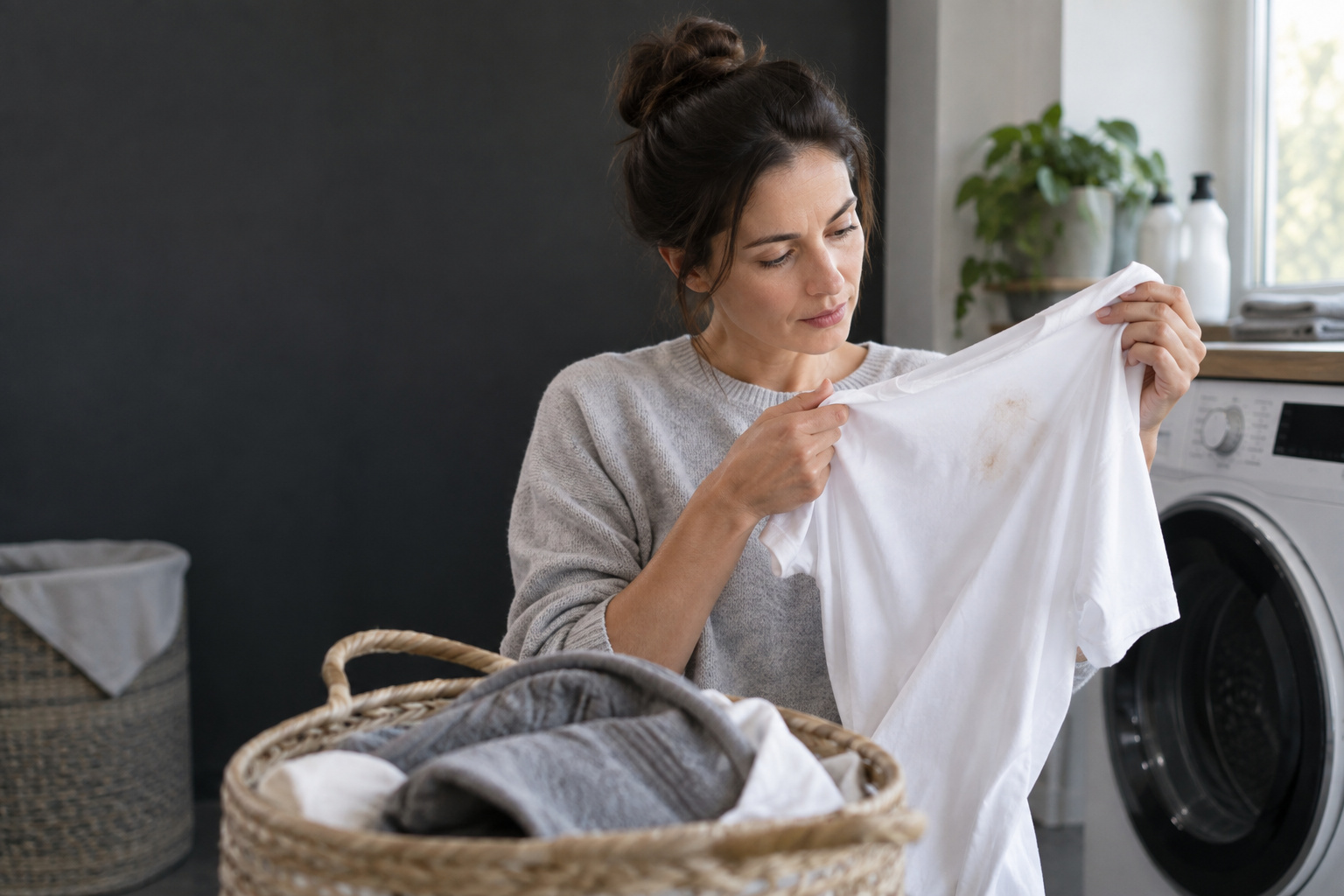
Sweat stains are a slow-building problem: the mark often appears after many wears, usually under the arms or along a collar, and it can show up as a yellow tint on whites or a darker patch on colors. This guide brings together what the American Cleaning Institute and two university extension services publish about perspiration stains on washable fabrics. It covers what to do first, how hot the wash can be, when enzyme products are suggested, what the extension guides say about color change, and where to stop. Everything here starts and ends with the care label and the product label; nothing below overrides either one.
How do you remove sweat stains? The short answer
Short answer To remove sweat stains from washable clothes, pretreat the area with a prewash stain remover, liquid detergent or bar soap, then launder in the hottest water the care label allows. If the mark persists, the American Cleaning Institute and Texas A&M AgriLife Extension point to an enzyme product or oxygen bleach, and the garment should be inspected before it goes in the dryer.
The American Cleaning Institute (ACI) lists perspiration as a stain you can usually handle in the wash: “Use a prewash stain remover or rub with bar soap. Launder using hottest water safe for fabric.” Texas A&M AgriLife Extension gives a parallel route: work liquid detergent into the stain, or soak the garment in warm water with an enzyme product for 20 to 30 minutes, then launder in the hottest water safe for the fabric.
- Pretreat: prewash stain remover, liquid detergent or bar soap worked into the marked area (ACI, Texas A&M).
- Optional soak: warm water with an enzyme product for 20 to 30 minutes, per Texas A&M, if the product label permits soaking.
- Wash: the hottest water the care label allows, with the recommended amount of detergent.
- Inspect: before drying; heat can set what remains.
If you are not sure the label permits warm water or any pretreatment at all, start with the care-label checklist before touching the stain.
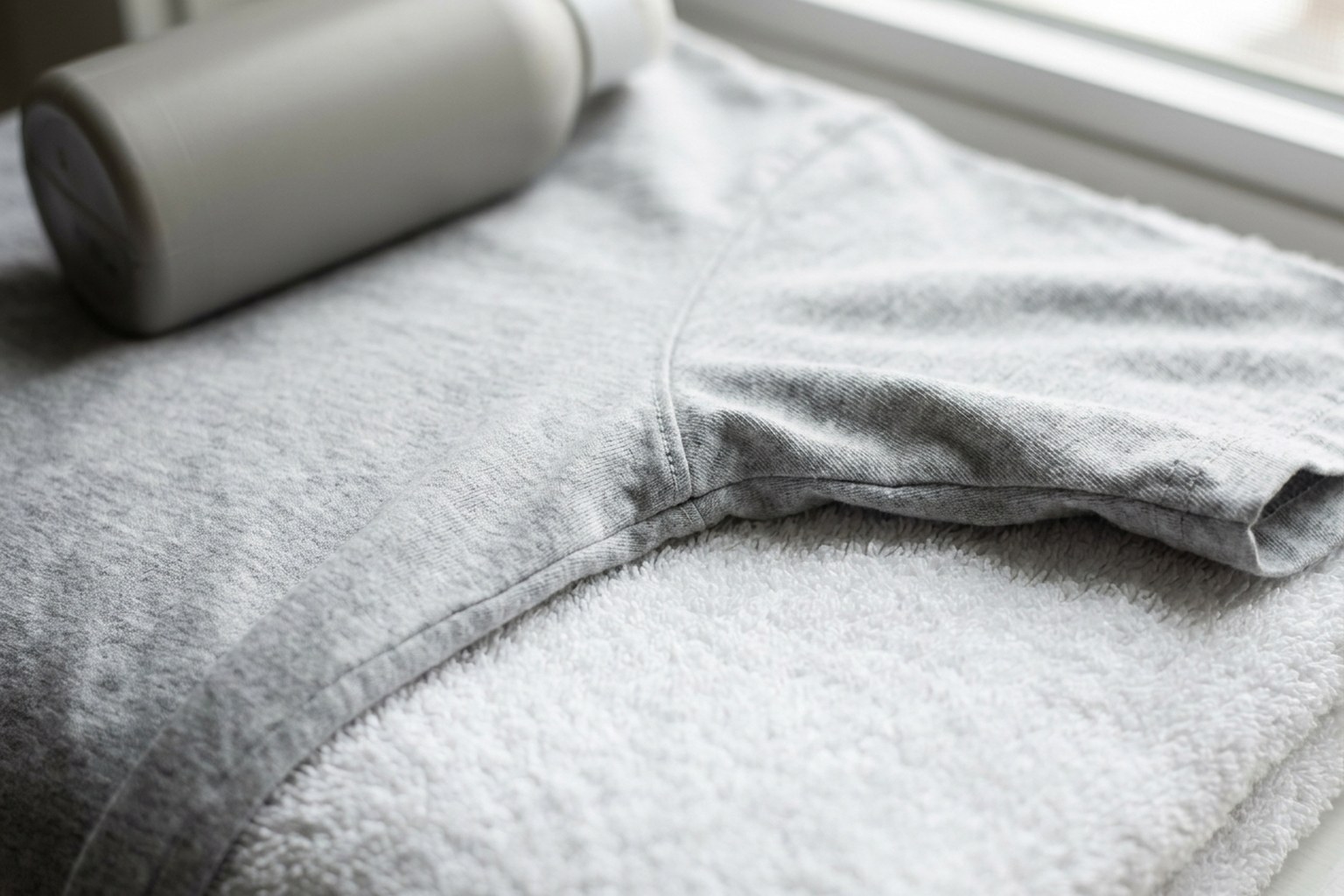
Why sweat marks build up and change color
Extension stain guides group perspiration with other body soils that respond to detergent and enzyme products. Texas A&M notes that enzyme products “aid in removing protein stains such as blood and meat broth, ground-in dirt, grass stains and perspiration, and in restoring whiteness.” That is why the same enzyme logic described in our guide to enzyme stain removers also applies here, provided the product label lists the fabric and the use.
Two things change the picture. First, a stain that is old is harder to shift: Texas A&M puts it bluntly, “Old stains may be impossible to remove.” Second, perspiration can alter the color of the fabric itself, not just leave soil on top of it. ACI addresses that case separately, and so does Texas A&M, which is why the color-change step below is not part of the first attempt.
- Fresh mark: responds to the standard pretreat-and-wash route.
- Repeated, old buildup: may need a soak and a second wash; may never fully disappear.
- Color change: a separate problem that the guides treat with a separate, single-chemical step.
How hot can the wash water be?
“Hottest water safe for fabric” is the phrase both ACI and Texas A&M use, and it means the care label decides, not the stain. New Mexico State University Extension spells out what that looks like in practice: wash “in the hottest water safe for the fabric—very hot for cotton and linen, hand-hot for synthetics such as nylon, and just warm for woolens.”
| Fiber | NMSU wording | What it means for sweat stains |
|---|---|---|
| Cotton, linen | very hot | Highest permitted setting, if the label allows it |
| Synthetics such as nylon | hand-hot | Warm rather than maximum heat |
| Wool | just warm | Gentle; check whether washing is allowed at all |
The Federal Trade Commission’s Care Labeling Rule requires a label to “give a water temperature setting if regular use of hot water will harm the product.” If you see such a setting, it caps the temperature you use, whatever the stain. Garments labeled for professional care belong in the delicates and dry-clean-only guide instead.
What to do when sweat has changed the fabric color
Both ACI and Texas A&M describe a color-restoration step for perspiration. ACI: “If perspiration has changed the color of the fabric, apply ammonia to fresh stains or white vinegar to old stains; rinse.” Texas A&M: “If fabric is discolored, try to restore it with ammonia if the stains are fresh, or with white vinegar if the stains are old. Rinse and re-launder.”
Read that as one product for one situation, never a combination. Keep every product separate. Washington State Department of Health warns: do not mix bleach with ammonia, acids or other cleaners, and it lists vinegar among the acids. Mixing bleach and ammonia produces toxic chloramine gases. Utah State University Extension adds the same warning for household cleaning: “Be careful not to mix ammonia with a bleach product as it can produce a harmful gas.”
- Pick one: ammonia for a fresh discoloration or white vinegar for an old one, as the guides describe; never both together.
- No bleach in the same session: rinse and launder before any later bleach step, and never combine bleach with ammonia or vinegar.
- Test first: try the step on a hidden seam allowance; stop if the dye moves or the surface changes.
- Ventilate: work in a well-ventilated space and keep products in their original containers.
The oxygen vs chlorine bleach guide explains why the bleach category, the garment label and the product label all have to agree before any bleach is used.
Stubborn yellowing and lingering odor
For marks that survive a normal wash, ACI says stubborn perspiration stains “may respond to washing in a product containing enzymes or oxygen bleach in hottest water safe for fabric.” That is a laundry-booster job rather than a spot-treatment one, so compare products on our laundry booster comparison, and use a pretreatment from the stain remover comparison for the mark itself.
| Situation | Step described | Source |
|---|---|---|
| Fresh perspiration mark | Prewash stain remover or bar soap, then hottest wash safe for fabric | ACI |
| Mark still visible | Work in liquid detergent or soak 20–30 min with an enzyme product, then launder | Texas A&M |
| Stubborn stain | Wash with an enzyme product or oxygen bleach in hottest water safe for fabric | ACI |
| Fresh color change | Ammonia alone, then rinse (never with bleach) | ACI, Texas A&M |
| Old color change | White vinegar alone, then rinse (never with bleach) | ACI, Texas A&M |
If the same shirt keeps coming back with a ring, the issue may be buildup that a single wash cannot reverse. Repeating the same step without a reason rarely helps; the guide to set-in stains explains how to decide whether another attempt has a realistic purpose.
Inspect before drying, and know when to stop
Texas A&M’s general rule is the last checkpoint in every route above: “Heat sets stains. Do not dry a stained fabric in the dryer or press it until you are sure all of the stain has been removed.” Air-dry the garment if any outline remains, then decide on a second attempt.
- Stop: if color transfers to a white cloth during a hidden-area test.
- Stop: if the fabric surface roughens, thins or changes texture.
- Stop: if the care label says do not wash, or you cannot read it; seek professional care.
- Accept limits: old or heat-set perspiration marks may be permanent, as the extension guides acknowledge.
Sweat stains overlap with deodorant residue, but the two are not the same problem. If the mark is white, waxy or stiff rather than yellow, read our deodorant guidance on this site and our inspection-first coffee and tea workflow, and treat one stain type at a time.
Sources and further reading
- American Cleaning Institute: Stain Removal Guide
- Texas A&M AgriLife Extension: Removing Stains From Washable Fabric (PDF)
- New Mexico State University Extension Guide C-502: Removing Clothing Stains (PDF)
- Federal Trade Commission: Clothes Captioning and the Care Labeling Rule
- Washington State Department of Health: Bleach Mixing Dangers
- Utah State University Extension: Home Cleaning Chemistry